A few years ago, Batsheva Cohen was walking through the streets of Hebron on a Friday night when a voice called out, asking her to close a window. She looked around and saw no one.
“I’m here inside the tent,” the voice explained. “I’m wearing my PJs, and I’m too cold. Do you mind closing my window?”
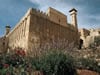
The tent belonged to one of the tens of thousands of Jews who come to Hebron each year for the Shabbat on which the weekly Torah portion of Chayei Sarah (which translates as “the life of Sarah”) is read. For one weekend, the streets of King David’s ancient capital fill with tents, sleeping bags and mattresses, as visitors arrive to spend Shabbat near Me’arat Hamachpelah, the Cave of the Patriarchs.
The city, one of Judaism’s four holy cities, is preparing to do it again. Last year, said Cohen—who co-directs Chabad-Lubavitch of Hebron, together with her husband, Rabbi Danny Cohen—police estimated that between 40,000 and 45,000 people came for the weekend, and similar numbers are expected this Shabbat.
Many visitors rent apartments in neighboring Kiryat Arba. Others sleep on classroom floors, in trailers or in the homes of local Jewish families. Some bring nothing more than a sleeping bag and find a spot under the open sky. The accommodations are rarely comfortable. Yet the visitors keep coming back.
This week’s Torah portion tells of Abraham’s purchase of the cave from Ephron as a burial place for his wife, Sarah, a binding business contract whose parameters are extensively detailed in the text. At the urging of the Rebbe, Rabbi Menachem M. Schneerson, of righteous memory, in the winter of 1976 Israeli ambassador to the UN Chaim Herzog submitted the contract between Abraham and Ephron to the UN. “For the first time in history,” the JTA reported at the time, “an agreement made almost 4,000 years ago and recorded in the Bible, has been issued as a United Nations document … .” The Rebbe told Herzog, who later became president of Israel, that his personal claim to Hebron was further bolstered by the fact that he was Levite, Hebron being one of the cities designated for members of that tribe. Herzog’s son, Isaac Herzog, the current president of Israel, was also present during this encounter.
By the time Abraham buried Sarah there, the Cave was already the burial place of Adam and Eve. Abraham would himself later be interred there, as were Isaac and Rebecca, and Jacob and Leah. On this Shabbat, their descendants come from across Israel and around the world to pray, sing and eat together in the city where they are buried.
Shira Jacobson of Jerusalem first came to Hebron for Shabbat Chayei Sarah in 2015 and has returned many times since, on occasion choosing it over other responsibilities.
“Kabbalat Shabbat at the Machpela can’t be described, only felt,” she says. “And all Shabbat long, you feel Avraham and Sarah’s presence as their children offer one another food and drink, just as they once did.”
The weekend, she says, “fills my whole year with the energy of Sarah Imeinu, the first Jewish woman, who teaches us to light up the world with holiness.”
‘Everyone’s Just Dancing Together’
The gathering began on a far smaller scale. Cohen recalls that the idea took hold at a time when many Jews were afraid to visit Hebron. Local residents wanted to give people a reason to come, and someone proposed a large Shabbat gathering for Chayei Sarah. About 500 people attended the first one, she recalls, among them her husband. Over the decades that followed, the numbers climbed into the thousands, then tens of thousands.
For the Chabad movement, the city holds a history of its own. Long before the village of Kfar Chabad was founded, Hebron was home to an important Chabad community, which included Rebbetzin Menuchah Rachel Slonim, daughter of Rabbi DovBer, the second Chabad Rebbe, known as the Mitteler Rebbe.
Visitors stop at her resting place throughout the weekend, and the program includes farbrengens and the singing of niggunim. What draws people to return, they say, is less the programming than the atmosphere that takes over the city.
Yisroel Schwartz, a student at Ohr Somayach yeshivah in Jerusalem, came for the first time last year. Walking toward the cave on Friday night, he passed what seemed like 20 different minyanim, each praying in its own style.
“This one’s Chabad. This one’s Breslov. This one’s Sefardi. This one’s Chassidish. This one’s Ashkenaz,” he recalls. “And everyone’s just dancing together. The joyous Jewish unity was something that I don’t think I’ve seen anywhere else.”
“We all come from Avraham, Yitzchak and Yaakov,” he says. “To stand alongside them, with tens of thousands of their great-grandchildren, you actually feel where you come from. You feel your heritage. You feel the connection.”

‘Coming Back To Their Parents’
Feeding the crowds takes planning. Last year, about 7,500 people registered for meals through Chabad’s hospitality operation, according to Cohen, and many more showed up. This year, two enormous guest tents will serve visitors with or without advance registration, though Cohen says it is much easier for them when people sign up. The Cohens host about 100 guests on their enclosed porch, and yeshivah students help run the larger meals in the tents.
Running a meal for thousands without microphones calls for some creativity. One year, organizers made large color-coded signs resembling traffic lights. Yeshivah students were assigned to groups of tables, and the signs told everyone when to sing, when to listen to a word of Torah and when to get up and dance. Guinness World Records once approached the organizers about recognizing the gathering as the world’s largest Shabbat meal, Cohen says, but they decided the requirements were too extensive to pursue.
Much of the hospitality happens outside the tents. Schachter is planning a potluck with 15 to 30 friends and expects to pick up more guests along the way.
“Usually what happens is that the families who live around there will end up coming with us or inviting us to the meal or just giving us food,” he says. “They just want to give to people. They’re so grateful to have people in the city celebrating with them.”
For residents of Hebron and Kiryat Arba, this Shabbat is particularly meaningful. Dan Cohen (no relation to the Chabad emissaries in the city), a local resident who runs a food truck for soldiers in Hebron in memory of his cousin, Elkana Sapez, finds it deeply encouraging to watch tens of thousands of Jews come to connect with their roots.
“There’s one Shabbat a year when tens of thousands come to connect with our father and mother, and we’re so happy about it,” he says. “It gives us a sense of security, knowing that we’re not alone in the effort to protect, visit and strengthen Hebron, the city of our forefathers.”

Batsheva Cohen describes the city on this Shabbat with the Hebrew phrase “Chevron b’si tifartah,’” Hebron at the height of its splendor. Many people hesitate to visit during the year for security reasons. On this Shabbat, families, students, soldiers and visitors from abroad fill the streets.
Not every year goes according to plan. Last year brought heavy rain and strong winds. Tents blew away, and soaked, freezing visitors came to the Cohens’ home to warm up before heading back out to their campsites.
“Everyone somehow managed,” she says. “But it’s an experience that you don’t forget.”
Schwartz’s tent broke that windy Friday night, and he spent the night on a stranger’s porch. He still counts the weekend among the best experiences of his life, and he is returning this year with his own tent, mattress, sleeping bag and raincoat. His advice to first-timers is simple.
“Get ready to rough it out.”
Batsheva Cohen knows families who could easily afford a hotel and choose to camp anyway, as an annual family tradition. Some visitors arrive days early to claim a good spot. Others fly in from abroad before Shabbat and leave soon after the holy day departs.
“It’s obvious why so many people come, and keep coming back,” she says. “It’s like a child coming back to their parents.”
To support Chabad of Chevron in their work, click here.